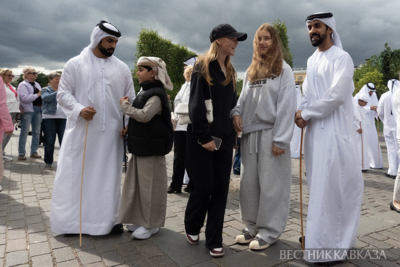
Yesterday in Vestnik Kavkaza’s studio, Russian senator Igor Morozov addressed the parliamentary delegations of Azerbaijan, Serbia, Cyprus and other countries to thank them for their vote against the PACE resolution which deprived Russia of voting rights in the structure of the Council of Europe. “Delegates from the parliaments of Austria, Switzerland, Denmark, Belgium, France, Germany and Italy contributed to it a lot. They also voted and spoke against restricted measures against Russia with high political courage,” Morozov said, expressing the view that MPs realize what is happening “on the big chessboard.”
160 MPs supported the resolution on depriving Russia of voting rights; 42 MPs voted against it; 11 abstained. Three Armenian MPs were suddenly among the number of those who abstained – members of the Republican Party Ermine Nagdalyan and Naira Karapetyam, and a member of Orinats Erkir, Mger Shakhgeldyan. There should have been more Armenian MPs in the PACE hall, but they were absent.

It is interesting that the position of “the strategic partner of Russia” – Armenia – was so unexpected that some mass media had included Armenian MPs on the list of Russia’s supporters in PACE automatically. A Latvian portal published an article headlined “Humiliation of Russia: How did Delegates vote?”: “Due to the situation in Ukraine, Russia was deprived of voting rights in PACE. It turned out that delegates of only four countries didn't support the PACE decision to the full extent – Azerbaijan, Armenia, Cyprus and Serbia.”
The Armenian MPs gave a very strategic and partnership explanation of their behavior: “Our delegation is small, and 3-4 votes couldn’t change anything or influence the results of the vote.”
Their hope to pretend that there was no problem and it would be solved somehow automatically didn’t come true. Artak Zakaryan, the head of the permanent parliamentary commission for foreign contacts, a MP from the Republican Party, had to make a statement: “Our delegation voted according to its interests. It cannot be considered as voting against Russia. Armenia is an independent state and relies on its own interests.”
It seems national interests were the reason for the epidemic among Armenian MPs who were absent from the PACE session. Opposition MPs and the secretary of Prosperous Armenia also failed to arrive in Strasbourg due to health problems.
It is difficult to say what Moscow will do. Obviously, its reaction is diplomatic and restrained. However, today Russia expects support from its allies like never before. Some experts think that the Armenian authorities are trying to draw Russia’s attention to their serious claims by such behavior in PACE.
However, considering Morozov’s words, Moscow has already come to conclusions and realized who are stable supporters of development of relations with Russia at a strategic level, and who follows tactical goals. Experts predict that Moscow’s treatment of the Armenian-Azerbaijani conflict will shift in favor of Baku, which doesn’t want to become a priority vector of Russian foreign policy, unlike Yerevan, but wants to get some support in certain regional projects from Moscow.