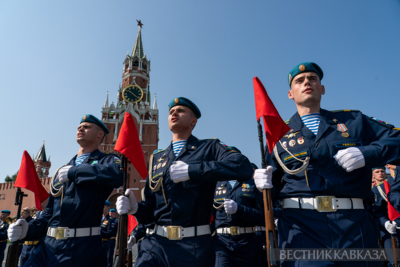
The Russian peacekeeping mission in South Ossetia began twenty years ago. The experts estimated the effectiveness of the presence of peacekeeping forces in the zone of the Georgian-Ossetian conflict and the background of the conflict.
Alexei Vlasov, editor-in-chief of VK
Historical context is closely involved in the events that occur around South Ossetia, as well as in all events that take place in the South Caucasus. No wonder the Georgian historians have produced voluminous studies, monographs, in which they justify the historical right of Georgia to the territory which they call Shida-Kartli, while in our historical terms, since 1830, when the term "South Ossetia" was used for the first time in the publication of Tiflis Gazett", if I do not mistaken, it has been always used, progressively displacing other names of this territory and of the current independent state. In fact, the history of the conflict in the XIX century is quite complicated. Actually, there was no conflict, because the illustrious princes, Machabeli and Eristavi invited their peasants to the lands that are now geographically located in the territory of South Ossetia. The peasants were mostly Ossetians; Tskhinvali, which was the only major trading city, traded in wool in the XIX century and was a rather large city by regional standards, was inhabited, if I remember correctly, by trading nations, i. e. the Armenians and the Jews.
There was not any local conflict until the middle of the XIX century when the local Ossetian peasants addressed to the local authorities protesting against the attempts of the Georgian princes to turn them into serfs. It is interesting enough that in late 30's and 40's. the papers on this subject reached even the Emperor Nicholas I who put a resolution to these documents. I will not give it word for word; the essence was the following: maintaining the current status of the Ossetian peasants is possible only by sending there punitive expeditions and military units. This requires significant resources, and therefore compensations to the Georgian princes for the loss of their serfs should be paid. The requirement to restore the status of serfs for South Ossetians - the letter says just "Ossetians", - was renounced. In fact, the central government protected the Ossetian peasants, even though for pragmatic reasons, in a veiled form in 1841 and later. Therefore, the specifics of the situation which developed in the XIX - early XX centuries was the fact that in this region Georgian and Ossetian villages were interchanging. The Georgian rulers did not leave their attempts to conduct a policy related to the imposition of the Georgian language, Georgian traditions and customs. But the Ossetian population was predominantly rural and piously preserved their traditions; to the early XX century, until the civil war in the region, this situation of quite fragile peace remained. In 1918-1920, something that Ossetian historians called the first genocide occurred: even before the events of August 2008 the Menshevik government of Georgia tried to restore the power of Tbilisi by force of arms in those areas that were predominantly inclined to the support of Bolshevik regime. The punitive expedition was sent there; they systematically destroyed the cattle and burned recalcitrant Ossetian villages. There was even a special commission after the establishing of the Soviet regime in Georgia which was engaged in the list of these losses and collected evidence. The ideology was as follows: the land is Georgian the Ossetians are aliens there, so they must obey to the will dictated from Tbilisi. Unfortunately, this methodological principle, which was first tried in 1919-1920, 70 years later, after Gamsakhurdia came to power in completely new historical conditions, was tested in South Ossetia. Of course, an important point is 1922, when, in fact, the commission dealing with the issue of national-state demarcation in the territory of Transcaucasia made a decision that historically defined the presence of South Ossetia within the Georgian SSR. In contrast to the Abkhaz, who had a lot of lobbyists in Moscow (among the Abkhazians there were a lot of writers, prominent public figures and members of the large top of the Central Committee, and they unsuccessfully tried to influence the authorities) South Ossetians were unlucky. Those letters, which, of course, were sent to Moscow, to the Central Committee, against the policy of the Georgian authorities in relation to Ossetians, often were not considered or did not reach the recipient. Of course, in the end of the 70s, in the decade that separates the beginning of the separation of the Georgian SSR from the Soviet Union, these trends of imposing Georgian culture, especially after the adoption of the constitution in 1978, if I am not mistaken, began to manifest more seriously; unfortunately, these trends were mostly ignored in Moscow. So it looked like a spring: where it is compressed more strongly, there is a gradual corresponding release of energy which quite naturally broke out in the period of 1988-1989.
Andrei Areshev, researcher of the Center for the Study of Central Asia and Caucasus of the Institute of Oriental Studies of Russian Academy of Sciences
The population of South Ossetia became a hostage of the difficult political processes in the Caucasus, during which the map of the region was randomly cut, and the people that already had a pretty daunting experience of mutual coexistence at that time, the coexistence of these people was acceptable, and it gave its fruits within a single powerful state, the Soviet Union. Although within the Soviet Union there were trends in both South Ossetia and Abkhazia relating to the reluctance of people in these countries or republics to be located in Georgia, because there were the facts of economic discrimination and the attempts of cultural assimilation. Strictly speaking, these attempts of cultural and linguistic assimilation, concerning the script and the Georgian language - all this was the catalyst of the process that occurred, particularly in South Ossetia in the late 80's and 90's, in particular, the attempt to translate all the paperwork into Georgian. This provoked mass protests of the intelligentsia which gradually affected almost all the Ossetian population of the republic. This eventually resulted in armed clashes even within the Soviet Union: we remember the famous march to Tskhinvali, who was commanded by the first secretary of the Communist Party of Georgia, Mr. Gumbaridze. This was due to different motives, but nevertheless it is what it is; it should not be removed from the history. There were mutual decision of a legal nature that was made in Tbilisi, then denied in Tskhinvali, and vice versa. Of course, the source and the initiator of the political and legal war was the Georgian side, the new Georgian leadership, headed by Zviad Gamsakhurdia, the nationalist, who declared nationalist slogans such as "Georgia for Georgians". I remember it well, because I had to visit the late Soviet Georgia. It was all quite natural, that is, the answer of the Ossetian population was quite natural. Originally, the Georgian side was the source and initiator of the conflict, and I would say that all the attempts to reach compromises in the case of both South Ossetia and Abkhazia were consistently torpedoed, and it was possible to do it even in the early stages of conflict. Such a one-sided and unitarist concept of a unified Georgian nation, of course, was sufficiently developed back in Soviet times in the writings of historians and the Georgian national ideologists. All of this played a destructive role, and, finally, the whole chain of these events led to the consequences mentioned before: almost genocide of the Ossetian people began in South Ossetia. Here we can recall Zar tragedy in May 1992 when the people in the bus were shot dead and targeted firings to Tskhinvali from Grad rocket launchers which were located on the heights surrounding the city and controlled by Georgian forces. Incidentally, concerning the origin of these formations, it is very interesting that when some of these launchers were destroyed by fire of the Russian aircraft from the air, Eduard Shevardnadze denied the fact that this forming is an integral part of the regular Georgian Army. It eventually played it role: the truce in the form of the so-called Dagomys agreements was reached. I would like to draw attention to one point: the tragic events in South Ossetia in May-June 1992 echoed in the neighboring North Ossetia which was part of the Russian Federation. Let us recall that in 1992 there was a difficult process of re-establishing the Russian state, in particular, signing a new Federation Treaty. So, the leadership of North Ossetia, of course, was not prone to any separatist encroachment; however, seeing what was happening in the south, it raised the matter that the situation must be resolved in some way, because that could not continue . Of course, the signing of the Dagomys agreements and the subsequent entry of the peacekeeping forces to South Ossetia, to Tskhinvali, the anniversary of which be celebrated tomorrow, on 14 July, of course, played a very positive role, and, I think that I'm not exaggerating, it prevented the development of events of a destructive nature, which could happen if these tragic and bloody events were not stopped, in the Russian Caucasus.
Yuri Krupnov, chairman of the Supervisory Board of the Institute of Demography, Migration and Regional Development
The arrival of the Russian peacekeeping contingent and, generally, the creation of joint peacekeeping forces 20 years ago, in fact, saved South Ossetia and the South Ossetian people as part of the Ossetian people as a whole, which is a very large, united and always patriotic people. The current event is quite unusual. We're not just talking about some instance in the legal sphere only of interest to professionals. In this issue the Russian state has acted on the basis of its thousand-year tradition; it established its type of world order at a local point. This type is determined by the top Russian diplomats and by Russian foreign policy. This is the first point. The second point is that this is an agreement which was signed in a very difficult year, as Andrei has already said, i. e. in the year 1992 (we remember Gaidar's reforms and the collapse of the Soviet Union); but despite this, I think this is an outstanding agreement, because a very simple form of the Dagomys agreement has been found in a very difficult situation. It was quite wise of Shevardnadze, of Yeltsin and of the advisers. They invented a form of joint peacekeeping forces, which are not UN peacekeepers, it is important to emphasize, according to the bilateral agreement, but nevertheless they are peacekeeping forces according to the UN Charter. The regional peacekeeping forces are authorized by the UN, they simply operate according to agreements among themselves, between the two countries. I think from the standpoint of the history of Russian diplomacy it is necessary to examine this agreement, and despite the difficult year of 1992, it is undoubtedly an outstanding instance. The next point is that we certainly understand very well, and the Russian leadership has also repeatedly stressed it, that none of us, neither the absolute majority of Russian citizens, nor our leadership, rejoice in the degradation of the relationship between Russia and Georgia. In this sense, I think in the next five years, the most important task will be substantial changes in our relations, but certainly without abandoning the principles of history, which are very complicated. So this anniversary, I think, should also be considered by the Georgian side, because it acted wisely 20 years ago. This is a bilateral agreement and not a unilateral one. And I think that it is necessary to properly evaluate the facts from the Georgian side, and maybe it will become the basis for a revision of our relations in the new situation within the framework of this historical vision. The next point is that, of course, taking into account the factor of Sochi 2014, we understand that the Caucasus has always been used to destabilize the situation as a whole, not only specifically in South Ossetia and other conflicts that exist. So, of course, it is very important to consider the Dagomys agreement and the establishment of a joint peacekeeping force from the perspective of a greater Caucasian policy. This may not work fully today, but it must be done, because only a stable Caucasus will allow us to adequately meet the financial and global economic crisis. I would like to pay special attention to the conflict in 2008, because in fact, as a result of this conflict, these agreements actually ceased to exist, and in late August they officially ceased to exist. But in this respect, I think today the attention paid to this conflict, besides all the accessible video footage of the events and all the unconditional aggression which cannot be commented on, is absolutely not enough. What happened from the standpoint of international law, and how can this event be characterized from the point of view of international law? Here, I think, the Russian diplomats don’t do their best, because it was not only the aggression of Georgia against South Ossetia, (it is a complex case because South Ossetia did not exist as a recognized separate state at the time). The point is that there was a cynical violation of the Dagomys agreements, and the Russian peacekeepers as part of the mixed forces were attacked. In this respect, Russia was not just defending South Ossetia, although she has always done it for 20 years, it is needless to say; the Russian Federation was obliged to protect its peacekeepers and the South Ossetian peacekeepers on the basis of the Dagomys agreements and of Articles 52 and 53 of the UN Charter. This is a fact, I even wonder why we did not use it fully, because Vitaly Churkin, to his credit, performed on the UN podium with a brilliant defense of our side, but the international aspect of this situation was not clarified enough. Everything was reduced almost to a war between Georgia and Russia. There was no war between Georgia and Russia. And when Mr. Saakashvili and the official propaganda of the Saakashvili regime spoke about this war and said that Russia was an occupier, an aggressor, and so on, even regardless of the facts from the point of view of intervention, in fact, Georgia attacked the peacekeepers and violated the Dagomys agreements signed by the same Georgians on June 24, 1992. These are the original, fundamental facts. In this regard, Vitaly M. Mitin, a lawyer from Novosibirsk, is working on promoting the proper explanation of what has happened, and I think our officials should consider this problem and deal with it seriously. Georgia must make all the conclusions on its real blame from the point of view of international law.
Sergei Mikheyev, Director General of the Institute of Caspian Cooperation
Quite often, when people speak about those years and use phrases like "the collapse of the Soviet Union was a disaster" or “the collapse of the Soviet Union was a tragedy”, a lot of people smile or make a wry face. Putin, who appeared in Europe and called the collapse of the Soviet Union a disaster, has caused a huge flow of criticism from western media, for which, of course, the disintegration of the Union was neither a tragedy nor a disaster. The situation that we recall today makes it clear that, indeed, the collapse of the Soviet Union was a disaster, not only at the global level, but at the personal one; it affected a great number of innocent people, thousands of whom were killed, tens of thousands became refugees. The catastrophe of these people grew into a global catastrophe with consequences on a planetary scale. I am absolutely convinced of it, because the world after the collapse of the Soviet Union did not become any more stable or safer, or more predictable, as we were told. Indeed, the South Ossetian conflict is evidence of the fact that it was a disaster, and unfortunately, the consequences of the disaster are still relevant to a large extent. And the second point is that I totally agree with the statement that the Russian peacekeeping mission could stop the possible genocide of the Ossetian people and generally focus on the role of Russia in the post-Soviet space. This role is extremely important.
Maybe someone does not like it, someone does not want to admit it, someone is irritated, but Russia, oddly enough, is the main guarantor of security and independence of all the post-Soviet states. All the former Soviet republics, although they do not want to admit it and seek their guarantors somewhere else, in fact, have the main guarantor of territorial integrity. It is Russia, and Russia will remain this guarantor. While Russia recognizes certain borders, these borders are not questioned. There is a huge number of potential conflicts such as the South Ossetian one in the former Soviet Union, I assure you. There is a large number of them in Central Asia, and they can break out at any time. There are a lot of them in Transcaucasia. They exist in the European part of the former Soviet Union. It is the loyal, balanced and stabilizing attitude of Russia that is the main guarantee that these conflicts do not erupt, do not begin and continue. I think it is necessary to recognize and understand it, although, of course, it is extremely uncomfortable for many countries, and many believe that Russia really does not matter. Imagine that Russia withdraws from some of the current post-Soviet regions, for example, from Central Asia. I assure you that within a few months several local wars will break out. This also concerns many other regions. So I think that it is extremely important to remember the South Ossetian conflict based of this situation and to draw conclusions for the future.