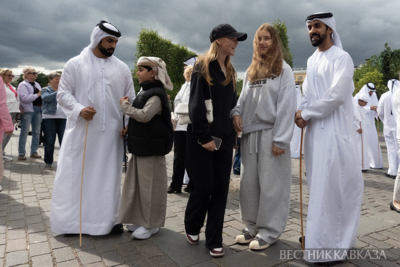
From June 28 to July 2, some 600 representatives of 16 Eastern Europe countries gathered in Strasbourg. The fifth university for democracy was held by the schools of political studies.
“The crisis of leadership” is the forum's topic. Secretary General of the Council of Europe Thorbjorn Jagland has opened the fifth Summer University for Democracy. The Russian Delegation consisted of 45 graduates of the Moscow School of Political Studies, its Director Yelena Nemirovskaya, Human Rights Ombudsman Vladimir Lukin, Vice-President of the Centre of political technologies Aleksey Makarkin and Institute of World Economy and International Relations representative Alexandr Krylov.
At the conference “Crisis of politic and democracy” VK journalist focused experts' attention on the connection between the system of crisis and the opposition's failures. National economies more and more depend on the International Monetary Fund, international financial institutions and transnational corporations. Yet these institutions are not in charge. The problem is, due to the globalization of economic and financial institutions opposition remains raw national and disintegrated. National governments can not defeat the world crisis, the crisis of the leadership is a sign of opposition's weakness, and opposition has to produce new leaders. Gert Weisskirchen, former member of the German Bundestag, pointed out that everything depends on political decisions. The situation that happened two years ago is a consequence of the 1970s political mistakes, he said. Zarko Puhovski, former President of the Croatian Helsinki Committee, replied that a world parliament is needed and Weisskirchen suggested developing a world code.
At the workshop “Crisis of leadership and crisis of politics, crisis of political legitimacy and public authority”, Francois Gilles Le Theule, Director of European Affairs, said that language problems should be resolved, and language barriers should be overcome. Leaders should learn CE working languages, know how to work in a team, because a transnational net of new leaders is a crucial issue. Christian Saves, political scientist and senior civil servant, agreed with his colleague. But the two experts had different views of European integration. Saves claimed that the EU should have strictly set geographic borders; he was against new members in the EU. Le Theule, on the contrary, said that countries with positive demography, such as Turkey, Algeria, Morocco, should enter the EU.
At the conference “Energy and security issues in the Black Sea region” issues of oil and gas transportation from Russia, Kazakhstan and Azerbaijan were discussed. Liana Jervalidze, expert from the Georgian Institute of Public Affairs, believes that there is no Russian monopoly on the oil supplies to Europe, after the Baku-Jeihan pipeline started work. The participants of the conference called on the experts to take into account interests of the civil society, and not that of the national elites and transnational companies.
Musa Musaev, Strasburg-Makhachkala. Especially for VK.
Council of Europe gathers anti-crisis leaders

3930 views