At the end of last week there were momentous reshuffles in Kazakhstan. The main one was the appointment of Dariga Nazarbayeva as the deputy prime minister. All other changes are 'trailers'. Experts believe that the script of the early parliamentary elections is being written in Kazakhstan and a 'transit of power' project is being prepared to be implemented.
President Nursultan Nazarbayev has launched a project for the transfer of presidential powers to the parliament and government. Appropriate amendments to the Constitution will be made before the end of this year. Under a strong prime minister, the Presidential republic may be transformed into a parliamentary one, or into a parliamentary-presidential one. In the summer the head of state said: "We have strong presidential power, as you know, there is a serious vertical. But as our middle class grows, the presidential power should probably be reduced, the government should be given an opportunity to work independently, and parliament ought to receive broader powers." At the same time, he said that at first it is necessary to "clean the entire state apparatus from top to bottom, to achieve making a state career only on merit. All specialists should pass all stages, positions, without any appointments."
Dariga Nazarbayeva is an experienced politician. She's been tested in the parliament, where she has developed the draft law 'On minimum social standards', which represents the biggest change in Kazakhstan's social security system, health and education from the time of the monetization of benefits. And now she was given the opportunity to realize it and to test herself in the sector of the real economy. The position of the deputy prime minister is a top managerial position, who should primarily be responsible for specific real sectors of Kazakhstan's economy and social sphere.
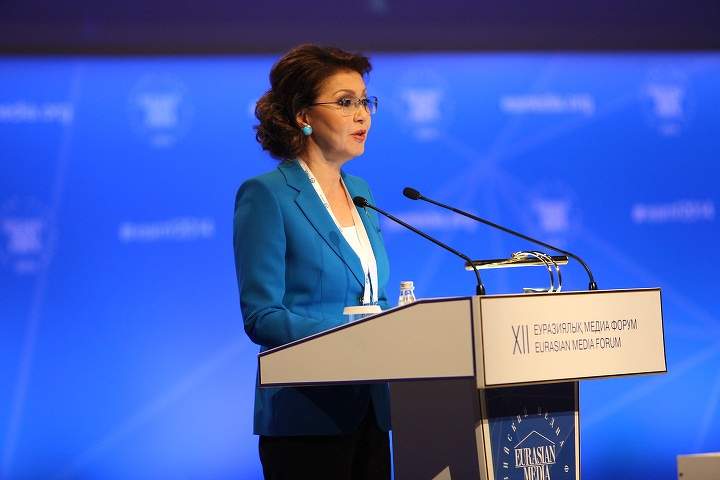
Last year Nursultan Nazarbayev demanded that the government keep the situation under control, so that the level of social tension wouldn't rise. However, not only the individual sectors of the Kazakh economy, but also the entire population have begun to suffer after the fall in world oil prices, the adoption of the anti-Russian sanctions, which rebounded on Kazakhstan, the devaluation of the Russian ruble and the national currency. Now, on the one hand, the President needs someone he can count on in difficult times. On the other hand, Nazarbayev is taking his daughter out of the strike, in case of a decision to hold early parliamentary elections in the republic, which are not discussed just by idle tongues.
"This appointment can be seen as a sign of a possible dissolution of the Majilis (the lower chamber of parliament) and early elections. By appointing Dariga to the government, the head of state actually takes her out of the situation which the Parliament has to go through, at least the Majilis," the Kazakh political scientist, the director of the Alternativa Center for Topical Studies, Andrei Chebotarev, said.
Kazakh analyst Pyotr Svoik doesn't rule out that this appointment is nothing more than a manoeuvre, leading Dariga Nazarbayeva to the premier's post. "According to the logic of the transition period, she had to take the post of the head of the ruling Nur Otan’s faction in the parliament, which was to become the main content of the upcoming parliamentary elections," Svoik said. However, instead of rising in the structure of the legislature, Dariga was transferred to the executive branch. This, according to the analyst, is not very clear, and the options and reasons for such a decision may be very different. In any case, the post is intermediate for Dariga Nazarbayeva, Svoik said, she should move on. "But then what to do with a very loyal assistant to the president – Prime Minister Karim Masimov?" the expert asked. In his opinion, there are not enough heavyweights in the structure of the Eurasian Economic Union (EEU), Kazakhstan is represented poorly there. "Maybe there are plans to move Karim Masimov to Moscow," Svoik said. "In general, the Ak-Orda (the residence of the President of Kazakhstan) is going through the strategic creation of a transitional regime. It is understood that because of the lack of direct inheritance, this transition will be carried out through a redistribution of the current exclusive presidential power." According to the expert, power "will be redistributed among the executive branch, the legislative branch and security forces." The figure of the future president, of course, will be significantly weakened compared to the current figure. The next president will be more a ceremonial official than the current head of state, Svoik believes.
The director of the Kazakhstan Group of Risk Assessment, Dosym Satpayev, also believes that the question of transit of power is primary and the issue of holding early parliamentary elections is secondary. "I think this appointment is one of the puzzles in a project called 'transit of power'. It's still more to do with an attempt by the head of state to strengthen some members of his family, providing them with additional functions and powers," Dosym Satpayev told Vestnik Kavkaza. He recalled that Timur Kulibayev (the president's son-in-law, husband of his middle daughter) was also tested in various positions. Kulibayev has become one of the main curators of the National Chamber of Entrepreneurs of Kazakhstan 'Atameken', which is the only officially recognized in the country lobbying structure in terms of the whole Kazakhstani business. The expert believes that the path to the premier's post for Dariga Nazarbayeva has been restricted. "And if it will happen under certain conditions, as a hypothetical scenario, then we can say that for the first time Kazakhstan may get a female prime minister," Satpayev noted.