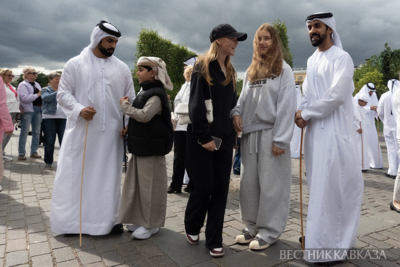
Centuries after the foundation of Gustavian Academy (university of Tartu) fortunes of Caucasian nations and Estonia have united here
Sequel. For part 1 please refer to: http://vestikavkaza.ru/articles/kultura/history/18146.html
http://vestikavkaza.ru/articles/kultura/history/18085.html
http://www.vestikavkaza.ru/articles/kultura/history/17869.html, http://www.vestikavkaza.ru/articles/kultura/history/17748.html и http://www.vestikavkaza.ru/articles/kultura/history/17336.html
The head of the Armenian National Union of Estonia, Artyom Davidyants, continues about the life of Armenians in Tallinn.
'Today there are several Armenian societies in Estonia: The Armenian National Union of Estonia, The National Union of Armenians of South Estonia, The Armenian National Community of Tallinn, The Union of Armenian Youth of Estonia, Estonian-Armenian National Community 'Ararat', the ethnic music band 'Atlas' and the Council of the Community of the Armenian Apostolic Gregorian Church in Estonia.
The very names of the communities tell much about their activities. These are culture, music, education, sports, and work with the young and old. And, of course, the church. Our church community has been a full member of the council of churches of Estonia almost from the very moment of its creation (www.ekn.ee). The various organisations get together when events of great importance take place.
Although not political organizations, the Armenian communities keep contacts with the main political powers of Estonia when necessary. The communities have good relations with the state, municipal sturctures, nongovernmental organizations and various foundations. They have particularly close relations with the Integration Foundation, the Education Ministry and the Culture Ministry. Relations with the corresponding ministries in Armenia and its embassy are as important. Our projects are supported. Not to mention our relations with our church. Usually we develop a project and ask some institution for support when the time to implement it comes. Our most important financial support usually comes from the Integration Foundation of Estonia. Each project is also supported by some members of the community. For example, the Education Ministry supports the school, the Integration Foundation provides financial support for the Union of Armenians of Estonia and supports various events at different times, for example the festival of Armenian culture, Aram Khachaturyan day etc. (www.meis.ee).
It is impossible to live in a society and not to be influenced by the other ethnic group, its traditions and customs. There are two ways to approach this - internal isolation and integration. If a family wants a good future for its child, it will care for his or her integration itself. This also opens up other possibilities. Of course, the children won't be identical in all ways to their compatriots from the ethnic homeland. This process develops of itself. Of course, having lived for years outside the homeland, one loses something. It is a natural process, otherwise one should not emigrate.
The most conservative things are some elements of family life and, of course, food. Nowadays, such things as lavash, Armenian cheeses and candies are quite popular in Estonia and can be bought in every store. It's not only expatriate Caucasians who take part in their production. For example, the bread is baked by the Finnish company "Father" which is situated in Tallinn. You can find prepared shashlik in every supermarket. Some can be hardly even called shashlik, but these are the inventions of local chefs. It is pleasant to know that Armenian brandy unites the tastes of Armenians and Estonians. So we have passed on some elements of our culture.
What is hard to get used to are the long, dark winters. But what can you do? It is my choice to stay here.
As for me, I married an Estonian 36 years ago, I have lived in Tallin for 34 years, I have three daughters and a son, my daughters live on their own. The eldest is a documentary maker and journalist, the middle one is a designer, the youngest is a journalist and musician. My son is still studying music, so he says. Or at least, he plays in his sister's band.
It is said, when in Rome do as the Romans do. If you decide to live somewhere abroad you have to think seriously about all the pros and cons. It is not a change of address, more a kind of change of identity, if not yours, then your children's , if not your children's, then your grandchildren's. In general, the European way of thinking and the Estonian mentality give us a broad space for choice'.
I remember the evening I was looking through a book about the monarchical dynasties of Europe. The wish to see portraits of long-dead kings was not a whim. I wanted to see the face of just one of them - the Swedish King Gustav II Adolf. In 1632 he founded the Academia Gustaviana (the university of Tartu) on Livonian land. Did he know that centuries in the future the paths of Caucasian nations and Estonians would combine in this sanctuary of science?
Mõis à-là Caucasienne. Armenians-2

4500 views