Summer in our country is expected to be near and above the norm. It won’t be cold. At the same time, there are no forecasts of extreme heat like there was in summer 2010. Summer is expected to be comfortable, according to Roman Vilfand, Meteorological Office Head.
He said that “in late April Moscow found itself not only in July from the point of view of climactic conditions, but also in a different climate zone. Such weather that was registered on April 28-29 is typical for June in Rostov and Krasnodar. And then a sudden fall in temperature happened. But statistics say that in early May Moscow experiences normal weather for the region. It should be like that.
As summer in Moscow came so early, the Meteorological Office decided to produce a new type of product from May. I mean the developed method of ultraviolet index. It is an important index. It is produced in major special meteorological centers in Washington, Toulouse, Brathnel. It characterizes the ultraviolet index according to the international scale. At the moment it is very warm in the east of our country. It is 5-6 degrees warmer than the norm. But the ultraviolet index is very low – only 2-4 units. The limit of comfortable ultraviolet is about 6 units. So it is very low, and it is connected with the fact that in the Krasnoyarsk Territory and Yakutia air is full of ozone, and ozone absorbs ultraviolet, i.e. solar energy. The only exception is Kamchatka. In the south of the peninsula the index is about 5-6 units. This is explained by warm and low-ozone air from anticyclones.
Low-ozone air will come to the European part of Russia. Its concentration will be less than normal by 10-15%. This means that the ultraviolet index will be close to 6 units, i.e. very comfortable. After the long winter, ultraviolet is benign. In the south of Russia – in the North Caucasus and the Black Sea region – the index will surpass the limit and will come up to 7-8 units. This means that from 13-15 p.m. it is better to avoid sunbathing, this especially concerns children and people sensible to ultraviolet.
In Spain and Portugal the index will be 7-8 units. In Cyprus and Japan – 9 units, in the Red Sea – 10-11 units. Only thick-skinned people can feel no influence of ultraviolet in these countries.
Therefore, new types of products will be regularly announced. This is very important for making decisions on walking and visiting beaches.
By May 9th we expect that the peak of flooding will end in the lower reaches of the Oka, at the moment it has been observed in the higher and middle reaches of the Oka, in the north of the Volga Federal District, in the higher reaches of the Kama and affluents of the Don. A water level increase is expected there. The water level in Lakes Ilmen and Chudskoe will reach its maximum limit. Residential areas are flooded in these regions. Lake Ladozhskoe will be free of ice by May 9th. A water level increase is expected today and tomorrow, but then it will stop and water will rush back. In Asia the spring floods are only beginning. The Lena has recently uncovered from ice. We expect flood peaks by mid-May. However, according to our experts, there is no threat of flooding in Lensk and Yakutsk like it was in 2001. But the Lena is a crafty river, it always has ice jams. The Rybinskoe and Gorkovskoe water reservoirs are getting rid of ice belatedly (3-4 days), despite the warm weather I’ve mentioned. Budding of trees and plants is happening 7-10 days earlier than it should be. The warmth couldn’t but influence agriculture. In general the situation is developing positively. In the Volga Federal District vegetation of winter crops started in April and now it is progressing. There is such a notion as “tillering,” so plants have tillered. The tilling capacity of plants varied from 2 to 3 sprouts per plant. The height is 10-20 cm. In the Volga Federal District the budding phase was observed 5-7 days earlier than normal. In other regions winter crops are growing successfully too. It guarantees that harvesting in late June will be fruitful.
We predict a positive index of winter crops. Productivity of winter crops surpasses productivity of spring crops twofold. In the Volgograd, Rostov and Astrakhan regions spring crops are reaching their normal characteristics and even advancing them by 5-7 days. It is interesting to say that the anomalous warm weather that was observed in April encouraged ripening of fruit trees. The border of budding advanced to the north to St. Petersburg, Kostroma and Izhevsk. In the central part of Russia apple and plum trees began to be covered with leaves 10-20 days earlier than average. Blossoming of peach, apricot and apple trees in the southern regions of the European part of Russia was poor because of winter frosts. Fruit cast was observed. We don’t expect a rich stone fruit harvest. In the Astrakhan region some heads of trees were damaged. This was the result of heavy frosts in February when the temperature lowered to -27 degrees.”
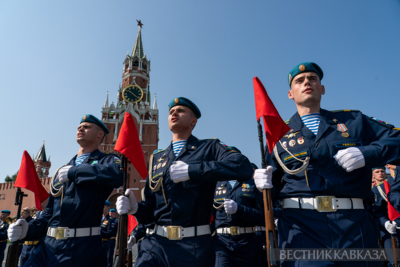
Speaking about modification of weather on Vicotry Day, Vilfand said: “We are preparing for it. The decision on providing modification will be made on May 8th, when the structure and morphology of clouds will be known and if they'll threaten the celebration. Of course, the forecast will be corrected every day in detail. At the moment we predict that on May 9th in mid-stratosphere high pressure will prevail. So we don’t expect heavy cloud formation. In the low stratosphere the pressure field is swampy, meaning pressure is close to the norm, 2015-2018 hPa, and in case of high temperature rain is possible. We have well-researched re-agents for the type of clouds that allow de-watering of clouds on the way to Moscow. We do not forecast a distinct frontal division that couldn’t be prevented.”