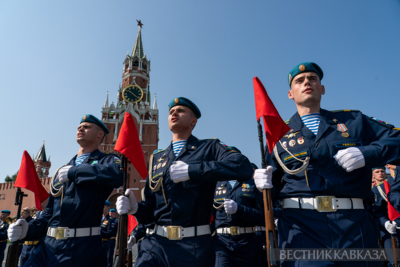
2011 was an important milestone in the implementation of military reforms and the state armament program. How do Russian military experts assess the course of changes in the sphere of national defense? How successful were consistent state efforts to strengthen the country's national defense? These and other issues were discussed by participants of the roundtable "Military and political outcome of 2011."
Igor Korotchenko, editor-in-chief of "National Defense" noted that the past year has brought fundamental changes in the international situation. Major international military and political players, in anticipation of the economic crisis, began to strengthen their positions through the use of military force and other technologies, related to bringing power to people whose governments and regimes might become their partners. The main result of the year was the realization that only with sufficient support from the military component can a state feel confident in today's world, Korotchenko said. The expert noted that in 2011 the government made great strides in military modernization. There is an objective to increase the number of professional contractors up to 425,000 by 2017. Korotchenko said that 20 billion rubles allocated for the rearmament of the army had already been transferred to the industry. "It is expected that measures to strengthen the nuclear component of the Russian Federation, as an important tool to Russia as a great power, will continue," Korotchenko said. Despite problems in the relationship that existed between the Department of Defense and representatives of the military-industrial complex, the state defense order was successfully contracted in its entirety in 2011. More than 80 percent of contracts for 2012 have been signed. Soon army combat units will be replenished with new uniforms, Korotchenko said. He believes that the Ministry of Defense has succeeded in "humanizing" the army. Korotchenko said that now soldiers are fully-fledged citizens of the Russian Federation. He also noted the success of the army in the transition to core military training of soldiers. "Today, soldiers are not engaged on any construction or agricultural sites, as they used to be, Korotchenko said. He also noted positive changes, such as increasing the salaries of military personnel and a draft project for the military police.
Viktor Litovkin, executive editor of the weekly "Independent Military Education", considers that the main achievement of 2011 was the completion of the first stage of military reform. The expert noted the importance of the zoning of Russia into four integrated military districts, which combined all branches of the armed forces and types of troops under one command.
Konstantin Makiyenko, deputy director of the Center for Analysis of Strategies and Technologies, sees as a major achievement of the year the adoption of the state armaments program and the initiation of the contracting process under this program. Large contracts for nuclear submarines and K-52 helicopters became the first long-term military contracts since the fall of the Soviet Union. Makiyenko also noted the launch of "Bulava" as one of the main events of the year.
"It is clear that, regarding foreign policy, the world is not becoming safer," Vasily Belozerov, co-chair of the Association of Military Political Scientists, said. Belozerov noted that events in the Arab world, the desire of Western countries to establish controlled regimes, as well as the deployment of anti-missile defense systems, are important factors determining the defense policy of Russia. Belozerov believes that 2012 will be critical. Great efforts are needed in order to maintain and continue the reforms undertaken in the past year, Belozerov said. According to the expert, a strategy should be developed to attract "decent" people for military service under the contract. He called to do everything possible to prevent interference of the army in the internal political developments in Russia. "We cannot allow the army to become a means of realizing of whatever political ambitions," Belozerov said.
Ilya Kramnik, an independent military expert, believes that the armed forces will continue the path of integration and unification in the next 10-20 years.
Alexander Khramchikhin, deputy director of the Institute of Political and Military Analysis, said that there is a threat of the expansion of the Taliban in Central Asia after the withdrawal of America and NATO from Afghanistan, scheduled for 2014. Khramchikhin believes that most likely the Taliban will come to power, and players such as America and China would be interested in the expansion of the Taliban to the north. This will lead to the interference of not only China but also Russia in the military conflict. Khramchikhin believes that America and China are interested in weakening Russia's military power and will play up military operations in Central Asia for this purpose, possibly with the help of Pakistan. The expert also believes that the current foreign policy situation is very similar to the climate before the First World War. "The next big war is inevitable, and apparently it will not be in Europe but in Asia," the expert said. Khramchikhin also believes that there are still a lot of Islamists in the North Caucasus. He suggested that their main base is currently in Dagestan. Khramchikhin also believes that a military conflict in Nagorno-Karabakh is inevitable.