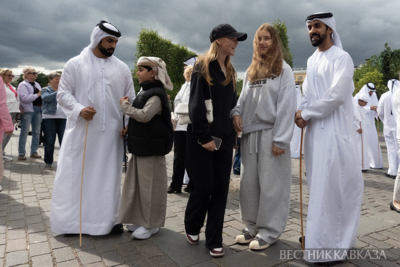
Timur Utsayev, Grozny. Exclusively to Vestnik Kavkaza
Boys were always admonished to make friends with science. In the 18th-19th centuries, one of the largest Caucasiologists of the 19th century, Baron Peter Uslar, noted that the numbers and degree of literacy in Chechnya were ahead of many regions of Russia in relation to the population. Then in each village there were schools, where teachers taught not only the precepts of the Koran, but also various languages and Chechen ethics and morality. In ancient times people believed that moral qualities should be formed from childhood, along with religious beliefs and education.
"Since the emergence of classical philosophy, the human mind has been considered the most important instrument of human progress. Not for nothing the slogan "knowledge is power" was discovered, which means in practice that the mind is the engine of civilization. From the late 19th century, science has recognized the brain as the main system of the body developing the human mind. Based on this postulate, we even determine the stages of human development in terms of the size of the brain. It turned out that the final stage of evolution of the brain does not belong to the mind but to morals and this was seen in people long before scientific discoveries. Today we can say that the definitions of man - "homo erectus", "homo sapiens", etc. - do not correspond to the realities, as a man becomes a man only when he becomes "ethical." This constant has long been sent to the "archives" of the human memory, which led the human race to its present degradation. Meanwhile, the people of the world were aware of this concept, but official "science" was looking at it from above," the Chechen ethnographer Said-Magomed Khasiev says.
The process of moral education of children was always carried out on the foundation of the unity and the relationship of social and spiritual life of man, took into account their individual differences and age, was to develop independence, awareness and social activity, as well as human conduct. "A Vainakh father should never praise his son. It was not ethical, the man could not boast in front of people. Even though he's your son, but at the same time, he must gain his name by himself. It's funny when you read the newspaper or watch TV - and when someone says: I have many children, my son works very well. It is not nice and not acceptable. Our people say that a son or daughter are personalities, and we try to educate them so that they create themselves. Children should certainly be proud of their father, but they do not have to work for him, on the contrary making themselves by their good works, they had to repeat the good and the noble created by their father or mother," M.Nashhoev stresses.
As the researchers wrote, in the late autumn and winter, when there was more free time, Chechen families were taken home to gather around the hearth. Older people talked about the past of their ancestors and the history of the people, and remember the heroic deeds of their grandparents, historical tales, legends, told stories, different legends and parables to the youth, guessed riddles, acquainted them with proverbs and sayings. Certainly, such evenings had a positive moral influence at a time when there were no secondary schools, radio or television. The representatives of the older generation of the current Chechen people say that the national pedagogy has its advantage over public pedagogy, the official system of education. Some regret remembering the period when the national pedagogy was forgotten, and in schools children should strictly obey or stand in the corner. In ancient times, under customary law, if the boy turned fifteen years old, he already had the right to ask questions and answer them. The boys could use this right during the famous Vainakh people's meetings on important public issues.
Today, the republic promotes the national customs, traditions and common law of the Chechens. In a society a complaint that the authorities are trying to break the tradition and impose either a Soviet way of life, or an Arab, Pakistani or Turkish one, is increasingly heard. The older generation calls not to destroy the centuries-old tradition, and recalls that Vainakhs survived in harsh exile in Kazakhstan, Kyrgyzstan and Uzbekistan, in Vologda and other places only due to these traditions. "Our culture is still there, not in our life but in our memories. We need to get it back into our lives. Our fathers were aware that the Chechens could be called an ethnic group that gave birth to a philosophy of humanity," the intellectuals say.
According to scientific sources, once people gave their sons to the Chechens for their education, at the time it was practiced by the peoples of the Caucasus. This is also described in Pushkin's poem "Tazit". Writer Ruslan Zakriev believes that the great Russian poet by all the force of his genius showed that courage, bravery, military prowess are only the surface, the visible part of the mentality of the Chechens, and in fact the essence of their nature is nobility. "The Adyghe Prince gave the Chechens his son for his education. In general, princes, loyal or rather forced to be loyal, gave children to the Chechens, who are portrayed in the press as opportunistic beasts having nothing human. I wonder what the Chechens taught Tazit? Did they make him a thief, a cannibal? No! Pushkin completely destroyed the propaganda of the time. Chechens made Tazit a honorable man, and it will be the highest nobility, which cannot be understood by a Gasub Prince, but it is clear and close to any Chechen. They will teach him generosity, which is so well understood by Pushkin, because he was a truly honorable man, for there is no Russian or Chechen nobility, this is a category - the attribute of elite, and nobility can be understood only by one who is himself a noble. And with brilliant insight this was showed by Pushkin in his poem."