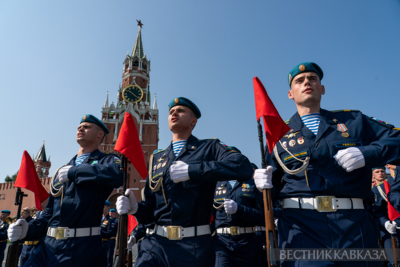
This year Russia and the world are celebrating the 70th anniversary of Victory in the Great Patriotic War. The importance of this historic event increases every year. The memory of the peoples of the former Soviet Union about that war is supported by common values. Victory Day, gained through unity - it is an opportunity to pay tribute to all those who fought and worked in the rear during the war. Vestnik Kavkaza remembers the people who led the country to victory. Today, Associate Professor of the History Faculty of Moscow State University Ismail Agakishiev recalls his grandfather, the Chevalier of the Order of the Red Star and the Order of Glory, Umud Dadash-oglu Aliyev.
In the Caucasus, especially in the mountain villages, an institute of authoritative people – aksakals – still exists. Grandpa Umud was a real, esteemed aksakal whose whole life was dedicated to serving the Motherland.
And his Motherland was not limited to the small village of Karakollug, the Ismayilli region, or even the whole of Azerbaijan. It was not limited to the scope of the USSR. My grandfather was a soldier of the world.
He had to stand up to defend the Motherland in the early months of the war. Umud Dadash oglu Aliyev was called to the front in August 1941, he began to fight against the Nazi occupiers in the Soviet Union, and he, like all Soviet soldiers, was destined to liberate Europe from the "brown plague."
Umud Aliyev received the Order of the Red Star for his heroism in the battle for the liberation of Moldova. And it is necessary to emphasize that the second front was opened by the allies of the USSR from the anti-Hitler coalition after the liberation of the entire territory of the USSR, when our troops entered the territory of Romania after the liberation of Moldova.
Grandfather also participated in the battle for the capture of Berlin, and was honored to stand as a guard of honor at the Potsdam Conference.


... Since the 1990s we have seen many attempts to revise the history of the Great Patriotic War, sacred to the Soviet people. Many attacks on the Soviet Union happened because of the war in Afghanistan, which lasted 10 years and claimed the lives of thousands of soldiers and officers. In Afghanistan my brother died, the pilot Azer Agakishiev. He could eject from the downed helicopter. "Agakishiev, jump!" – He received a command from the ground. But he said: "Our guys are in the helicopter, and they don’t have a parachute!" Azer crashed along with other Soviet soldiers.
In the 20th century the Soviet Union led two very different wars - that war in which my brother died, and the other war, where my grandfather fought. The USSR lost the war in Afghanistan, which dispelled the myth of the invincibility of the Soviet army, and the Afghan war was one of the reasons for the collapse of the country. The loss of traditional values led to defeat in Afghanistan – at that time people had already started to divide into the children of the rich and the poor, the children of ordinary mortals and those of senior officials. For the first time during the existence of the Russian Empire and the Soviet Union, the concepts of honor and dignity moved into second place. The Afghan war became a "thankless mission of mere mortals." Passion for dishonesty enrichment has become the norm, and personal interests caused betrayal by the people in the higher echelons of power, which ultimately led to the collapse of a great country.
Those who chose the path of dishonest enrichment, while enriching themselves materially, lost their moral foundations. For them, the concepts of honor and homeland became empty, they had no idea how to sacrifice their own lives fighting for their Motherland – a kind of manifestation of the psychology of the traitors who were policemen in Nazi-occupied territories. Many years later, the great-grandchildren of these people created skinhead groups in the early 2000s, shouting "Heil Hitler" and killing innocent people, sowing national discord and shaking the foundations of the new Russia. Moreover, those who controlled these people were often endowed with public authority.
During the Great Patriotic War in 1941, the enemy was raging outside Moscow, but in 1945 it was defeated in Berlin. The Soviet people, relying on idealism, were able to defend their homeland, their brothers and sisters, their fathers and mothers, their wives and children. Is there higher honor for a man? It is no coincidence that the first appeal of the country's authorities to the people during the war began with the words "Dear brothers and sisters."

Umud Aliyev belongs to the generation of winners. He had something that money cannot buy – he fulfilled his sacred duty as a soldier, a man, a kishi. All his life he held his head high. In peacetime, occupying various party and economic posts, he did his job with a sense of sacred duty and remained a crystal clear man, never claimed to be something that he did not work for, helping people, leaving no one in trouble.People came to him not only for help, but more often for advice. My grandfather was the honor and pride of the village, the district. You should have seen with what respect his fellow villagers welcomed him, with what undisguised nobility they treated him. Villagers said that they experienced a sense of purification, pride and grace while communicating with this wise and noble man.
Grandfather from the beginning was suspicious of Gorbachev, calling him a "washer of bones", and thought that this man, like Khrushchev, could destroy the country. A man who had gone through all the horrors of war did not understand how it was possible to inflate ethnic conflicts in their own country. When I came to grandfather during my student holidays, he sadly said that Gorbachev was able to do what Hitler failed to do. Grandfather did not understand how one can try to divide land between the Caucasus countrymen, even if the root of the word "countrymen" in Russian means "land".
Grandfather Umud dreamed that there would be peace in the Caucasus, but did not live to see this day.