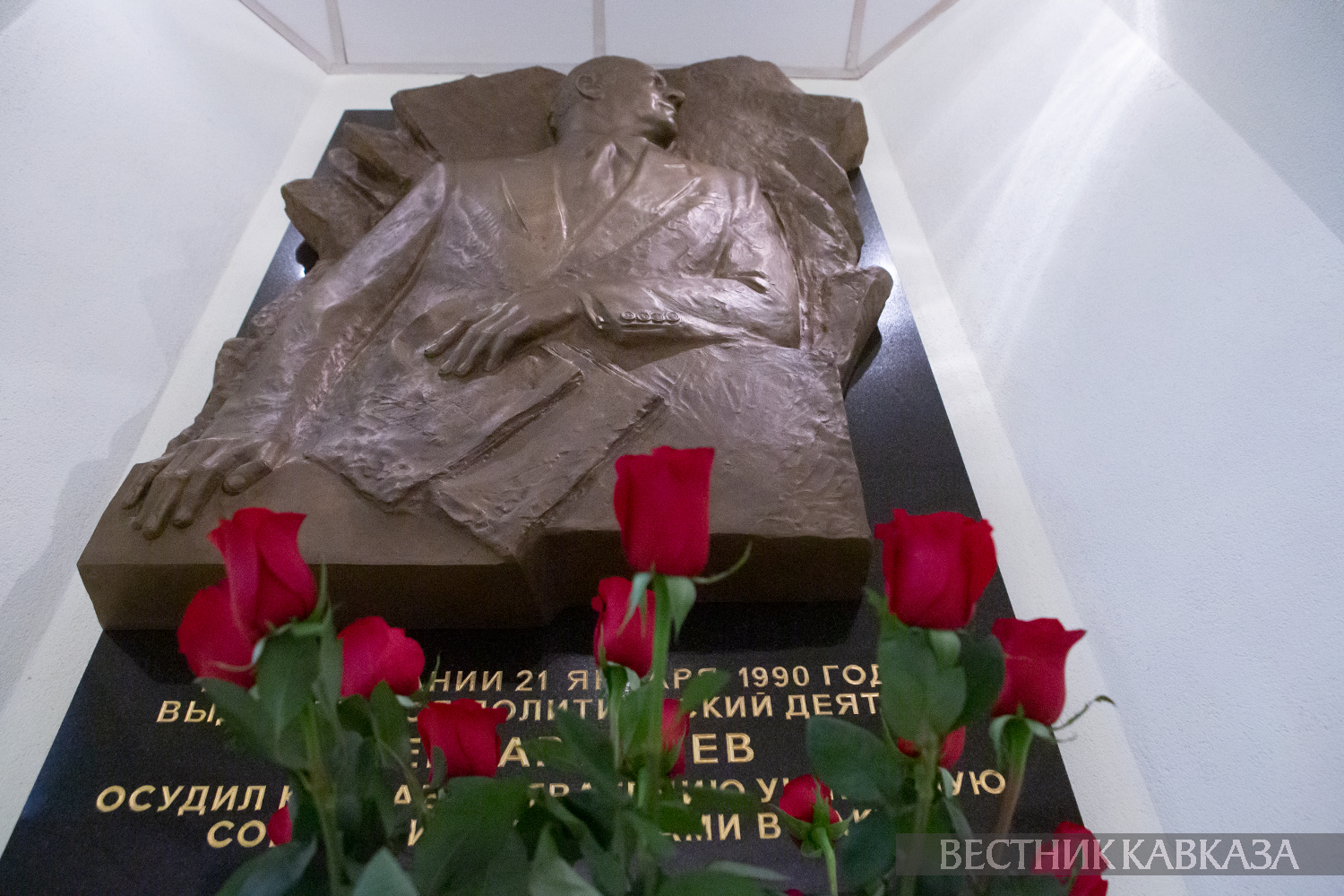
22 years ago, on December 12, 2003, Azerbaijan experienced one of the most significant losses in its modern history – the passing of National Leader and President Heydar Aliyev. This date is now observed as Heydar Aliyev Remembrance Day, marked by annual events in Azerbaijan and allied countries to commemorate the statesman who built the republic's economy and political system twice: during the Soviet era and again after the restoration of Azerbaijan's independence.
Modern Azerbaijan is built upon the foundation established by Heydar Aliyev. The state development models he created enabled the realization of the republic's strategic goals for over two decades, the first of which was the restoration of territorial integrity achieved in 2020 and 2023 with the liberation of Karabakh and Eastern Zangezur from Armenian occupation.
The life of Heydar Aliyev
Heydar Aliyev was born on May 10, 1923, in Nakhchivan. He began his career in public service at a young age, joining state security agencies in 1944.
In 1969, the Soviet leadership entrusted him with governing the Azerbaijan SSR. For 13 years, Aliyev pursued the comprehensive development of the republic, achieving notable economic progress and the formation an Azerbaijani ideology to safeguard historical memory and national identity.
His successes in Azerbaijan were so significant that in 1982, he joined the Politburo of the Central Committee of the Communist Party of the Soviet Union and serving as First Deputy Chairman of the USSR Council of Ministers, where he managed complex economic and security tasks.
However, in 1987, with the beginning of the Armenian-Azerbaijani conflict, Heydar Aliyev resigned from public administration. In 1991, he renounced his Communist Party membership in protest against Soviet policies in the South Caucasus.
With Azerbaijan's regained independence, the nation urgently needed the return of an experienced leader. Aliyev first led the parliament of the Nakhchivan Autonomous Republic and served as deputy chairman of Azerbaijan's Supreme Soviet. In the summer of 1993, during the peak of the Karabakh War, he was called to Baku.
On June 15, he became Speaker of the Azerbaijani Parliament, and on June 24, he assumed the duties of President. Three months later, on October 3, the Azerbaijani people officially and democratically elected Heydar Aliyev as President.
For the next decade, Aliyev worked tirelessly to save Azerbaijan from disintegration and civil war, then focused on consolidating the state domestically and internationally. The occupation of Azerbaijani territories by Armenian troops was halted, and the Contract of the Century was signed, sparking the interest of major global players in Azerbaijan's long-term stability.
During these years, thanks to Aliyev's efforts, Azerbaijan's multi-ethnic and multi-religious society united around the strategic goal of protecting sovereignty and national identity.
Heydar Aliyev passed away on December 12, 2003, at the Cleveland Clinic in the USA. He is burried in the Alley of Honor in Baku.
In memory of Heydar Aliyev
Traditionally, on Remembrance Day, President Ilham Aliyev visits his father's grave in the Alley of Honor. Other members of the Azerbaijani leadership, military personnel, foreign ambassadors, and civil society also pay tribute to the national leader.
Another tradition on December 12 is for those who knew Heydar Aliyev personally to share their memories. Vestnik Kavkaza, with support from the Heydar Aliyev Foundation, published the book "Walking Ahead: On the 90th Anniversary of Heydar Aliyev" in 2013, compiling recollections from global public figures. Excerpts are presented below.
Yevgeny Primakov
The legendary Russian diplomat, former Foreign Minister and Prime Minister, described Heydar Aliyev as an undeniably outstanding figure who "raised Azerbaijan, making it one of the most developed republics in the country".
"He was the first from Transcaucasia to join the Politburo and received the title of Hero of Socialist Labour. This likely aroused jealousy among his neighbours. However, Aliyev's promotion to Moscow was a deserved and correct decision",
Yevgeny Primakov said.
Primakov noted that Yuri Andropov held Aliyev in high regard, insisting on his transfer to Moscow as First Deputy Chairman of the USSR Council of Ministers soon after becoming General Secretary.
"This was due not only to Heydar Aliyev's outstanding qualities, but also to the fact that he had once headed the KGB of Azerbaijan. Obviously, this was also explained by human sympathy for Heydar Aliyev. One day (Aliyev was still Secretary of the Central Committee of the Communist Party of Azerbaijan), we were driving in the car, and Andropov, who was then vacationing in the North Caucasus, called him in the car. The guard and I got out of the car. What they discussed, I don't know, but the very fact that Andropov called him is significant",
Yevgeny Primakov said.
The last time Yevgeny Primakov, already Minister of Foreign Affairs, met with Heydar Aliyev was during his presidency of the Republic of Azerbaijan. This was at the height of the Karabakh War, and Primakov was to conduct a prisoner exchange between Azerbaijan and Armenia.
"When I came to him, he said, 'I'll release everyone except those three people on death row for murder.' I replied, 'Heydar Aliyev, then everything will fall apart. The Armenian side agreed only to a parity exchange, everyone for everyone.' He thought about it - and that's just him! - and said, 'Fine, I'll release those three too!' He knew the criticism this would provoke from his opponents, but he took the only right and wise step - the action of a truly outstanding politician",
Yevgeny Primakov said.
Shimon Peres
The legendary Israeli politician, former Prime Minister and President, and Nobel laureate described Aliyev as a perceptive and strong-willed leader.
"He understood that in a changing world, he would have to expose Azerbaijan to global influences, and, as he noted in his speech at one of the World Economic Forums: 'We are taking the first step toward actively integrating Azerbaijan into the global economy to demonstrate that our country is open to foreign investment, business, and mutually beneficial cooperation'. He quickly realized that keeping pace with the global economy means prosperity, while being tied to a limited national economy will lead to poverty",
Shimon Peres said.
Peres met Aliyev at the World Economic Forum in Davos, following the signing of the "Contract of the Century."
"I was struck by his inexhaustible determination to achieve a better future for his people by fostering economic growth and opening Azerbaijan to a new and changing world, coupled with the religious freedom that prevailed during his presidency",
Shimon Peres said.
The Israeli politician expressed confidence that, thanks to Heydar Aliyev's policies, Azerbaijan would develop for many, many decades.
"Considering the foundations established, the recognition achieved by Azerbaijan, and the strength gained from its current policies, I believe Azerbaijan will continue experiencing economic growth. Its role as a significant player in the international arena will strengthen, earning the respect of the global community and ensuring stability and prosperity for its citizens",
Shimon Peres said.
George H.W. Bush
The 41st President of the USA highlighted Aliyev's role in establishing US-Azerbaijan relations and preserving Azerbaijan's independence.
"His personal contribution to the establishment of the friendly relations between the USA and Azerbaijan as well as to the preservation of Azerbaijan's independence, is of paramount importance. The determination he demonstrated in seeking a just resolution to the Nagorno-Karabakh conflict through peaceful negotiations played a crucial role in establishing regional stability",
George H.W. Bush said.
The 41st US President added that Heydar Aliyev's work in laying the foundations of Azerbaijani statehood ensured the republic's confident entry into a new sovereign life in the third millennium.
"At the same time, his position and actions played a crucial role in attracting large-scale foreign investment, which strengthened Azerbaijan's economic position. These achievements contributed to the improvement of the lives of millions of Azerbaijanis and created all the conditions for Azerbaijan to enter the 21st century as an independent state",
George H.W. Bush said.
Hans-Dietrich Genscher
The longtime German Foreign Minister Hans-Dietrich Genscher emphasized that Aliyev laid the foundation for modern Azerbaijan back in the Soviet period, and that the national leader contributed significantly to strengthening the identity of the Azerbaijani people through an understanding of their history and culture.
"These far-sighted steps by Heydar Aliyev had an impact after Azerbaijan declared its independence, creating fundamentally different and better opportunities for the country's dynamic development. Thanks to Heydar Aliyev, Azerbaijan effectively exploited the window of opportunity offered by the Soviet Union's new policy in the second half of the 1980s. The country seized the chance to embark on a path of independent development. At all times, his policies were distinguished by conceptual clarity, responsibility, and foresight",
Hans-Dietrich Genscher said.
Genscher noted that the role of figures such as Heydar Aliyev and his son Ilham Aliyev in history cannot be overestimated, as they directly influenced the contemporary political and economic well-being of the Republic of Azerbaijan.
"Azerbaijan has been blessed with a rare fortune: in the early years of its independence, the country was guided by a leader whose personal authority, clear understanding of goals and objectives, determination, and sense of responsibility made a lasting impact on all who encountered him. This observation stems from my personal experience. Azerbaijan is fortunate that Ilham Aliyev, the current president and successor to Heydar Aliyev, is creating new opportunities for the nation based on the groundwork laid by his predecessor in our rapidly changing world",
Hans-Dietrich Genscher said.
Leonid Kuchma
The former Ukrainian President regarded Aliyev as one of the most prominent leaders in the post-Soviet space.
"He established the fundamental principles of Azerbaijan's statehood, created a stable governmental system, and effectively led the nation until the end of his life. Despite his serious illness, Aliyev successfully passed power not simply to to his son, as is often simplified, but primarily to a trusted associate and ideological ally. This transition guaranteed the stability and continuity of Azerbaijan's political course, positioning it as a respected nation not only in the Caucasus region",
Leonid Kuchma said.
Alexander Ivanov
Heydar Aliyev's head of security and former head of Interfax-Azerbaijan recalled the leader's personal character.
"Some leaders don't like to come down to earth, but he demonstrated no contempt for the people. He is a man of God, unique. Everyone around him, including his colleagues, felt his and his wife's warmth and attentiveness... Notably, within our organization, referred to as the 'nine' (now the Federal Protective Service), there exists a professional term "master". However, we always called Aliyev as 'father'. And not only we, the security service, but others as well. And that's how it remains - Father, Father of the Azerbaijani people",
Alexander Ivanov said.
The Republic of Azerbaijan and the Azerbaijani people will forever preserve the memory of the great leader Heydar Aliyev as the architect of their history and modern era.