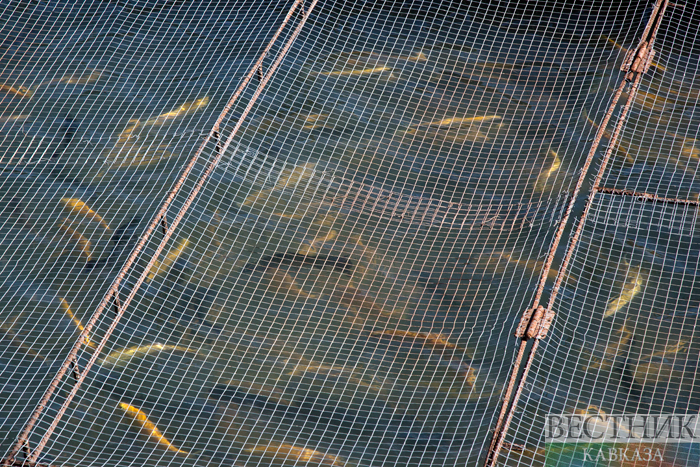
Azerbaijan aims to increase its annual aquaculture production from the current 3,400 tons to 7,700 tons by 2030, Azerbaijani Minister of Agriculture Majnun Mammadov said at the First Azerbaijan Regional Aquaculture Forum held in Baku.
The minister said the increase would help improve the supply of the domestic market with locally produced goods, reduce dependence on imports and expand export opportunities.
According to him, the State Program for the Development of Agricultural, Fisheries and Aquaculture Production and Processing in Azerbaijan for 2026-2030, approved by an order of President Ilham Aliyev, sets out the key priorities for the coming years.
"The program envisages bringing the legal framework for fisheries in line with international standards, digitalizing management and oversight mechanisms, protecting fish stocks and modernizing fish-breeding facilities. It also aims to identify suitable production areas, strengthen breeding capacity, establish an aquaculture agro-park, and develop subsidy and incentive mechanisms," Mammadov said.
He emphasized that the development of fisheries and aquaculture creates significant opportunities to strengthen food security, increase employment in the regions and promote entrepreneurship. Realizing this potential requires the introduction of modern technologies, the integration of scientific knowledge into production and the promotion of investment.
The minister added that the establishment of the Fisheries and Aquaculture Center had created the necessary institutional framework for the sector's development under a unified approach. The center's key areas of activity include protecting aquatic biological resources, restoring fish stocks and preventing illegal fishing.
"We attach particular importance to supporting business initiatives, encouraging investment, expanding access to modern technologies and increasing the production capacity of existing facilities," Mammadov said.
The minister also highlighted the importance of expanding cooperation with Caspian littoral and neighboring countries in scientific research, specialist training and technology exchange.