
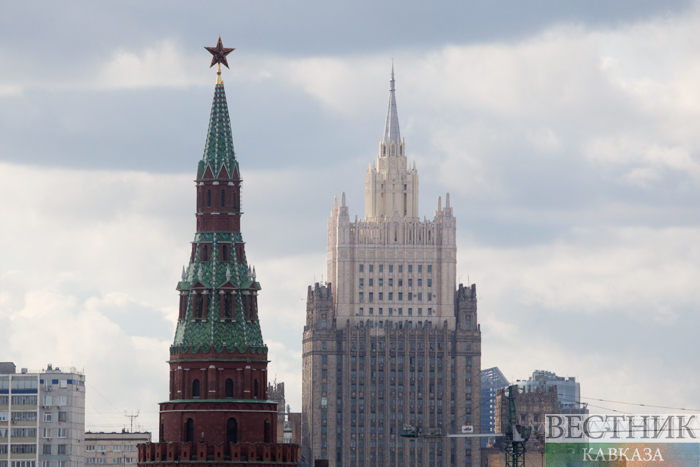
Moscow has welcomed the agreement between Washington and Tehran aimed at resolving their military conflict, the Russian Foreign Ministry reported.
"We appreciate the remote agreement reached by the presidents of the U.S. and Iran to bring an end to hostilities between the two nations," the ministry said.
The ministry commended the dedicated and effective efforts of Pakistani and Qatari mediators in facilitating negotiations and working toward a peaceful resolution.
According to the ministry, during the upcoming sensitive and crucial period of developing a comprehensive agreement, it is imperative that all parties involved in the armed conflict strictly adhere to the Iranian-American understandings reached and prevent a new dangerous surge of tensions in the region, including those in Lebanon.
The ministry expressed hope that the establishment of peace will contribute to mending trust in relations between states on both sides of the Persian Gulf, and the resumption of safe and unimpeded navigation through the Strait of Hormuz will help mitigate volatility in global energy and food markets.
"Iran's reaffirmation of its unwavering commitment to the Non-Proliferation Treaty is the best response to any attacks and unfounded accusations against Tehran from those who may try to challenge its legitimate rights to develop and use nuclear energy for peaceful purposes," the statement reads.
The ministry noted that Russia has provided an objective and uncompromising assessment.
"Throughout the conflict, it has maintained a responsible and high-principled position at the UN and other international forums, and has done everything in its power to reduce confrontation and facilitate a political resolution. We express our readiness to continue to provide significant diplomatic support for efforts aimed at sustainable and long-term stabilization in the Middle East," the ministry emphasized.
Earlier, Moscow presented its Arab and Iranian partners in the region with an updated version of the Russian Concept for Ensuring Collective Security in the Persian Gulf, which envisions a phased approach to resolving conflict situations, the principle of unified and indivisible security, the development of confidence-building measures, and ensuring freedom of navigation in the Strait of Hormuz based on international law.
"We hope that this initiative will stimulate a substantive discussion of ideas and proposals for shaping a new post-conflict architecture for interstate relations in this strategically important region of the world," the ministry concluded.





